
Building a Multi-Tenant SaaS Platform on AWS
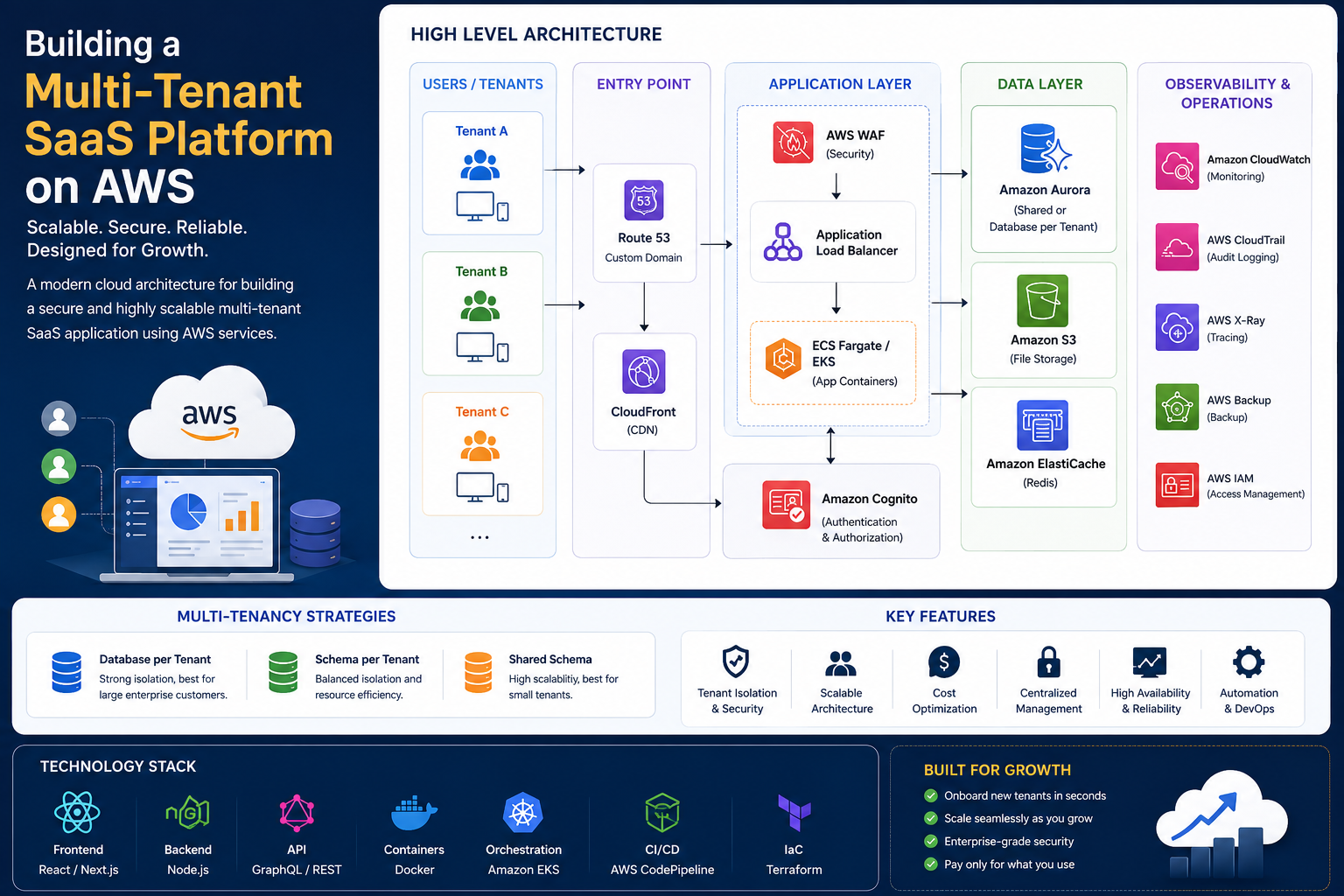
Designing a SaaS platform isn't simply about hosting one application for multiple customers. It's about creating an architecture that is secure, scalable, cost-efficient, and easy to evolve as your customer base grows.
Table of Contents
- Introduction
- Understanding Multi-Tenancy
- Choosing the Right Tenant Isolation Model
- High-Level AWS Architecture
- Authentication with Amazon Cognito
- Tenant-Aware Authorization
- Database Design
- Backend Architecture
- API Gateway Design
- File Storage Strategy
- Event-Driven Processing
- Deployment Strategy
- Monitoring & Observability
- Security Best Practices
- Scaling Considerations
- Common Mistakes
- Conclusion
Introduction
Software as a Service (SaaS) has become the dominant software delivery model. Whether you're building an HR platform, CRM, project management tool, learning management system, or healthcare solution, one challenge always appears:
How do you securely serve thousands of organizations from a single application?
A well-designed multi-tenant architecture enables you to:
- Reduce infrastructure costs.
- Simplify deployments.
- Scale efficiently.
- Maintain strong tenant isolation.
- Deliver consistent user experiences.
Throughout this guide, we'll design an enterprise-ready SaaS platform using modern AWS services and a Node.js backend.
What is Multi-Tenancy?
In a multi-tenant application, multiple organizations share the same software platform while each tenant's data remains isolated.
                    SaaS Platform

        +-------------------------------+
        |           Application         |
        +-------------------------------+

          Tenant A
          Tenant B
          Tenant C
          Tenant D
Each tenant has:
- Users
- Roles
- Permissions
- Business data
- Storage
- Settings
while sharing the same deployment.
Tenant Isolation Models
Choosing the right isolation model affects scalability, cost, security, and operational complexity.
| Model | Isolation | Cost | Complexity | Best For | |-------|-----------|------|------------|----------| | Shared Database, Shared Schema | Low | Low | Low | Startups | | Shared Database, Separate Schema | Medium | Medium | Medium | Growing SaaS | | Separate Database per Tenant | High | High | High | Enterprise & Regulated Industries |
Shared Schema
Users
Orders
Products

tenant_id
Advantages:
- Lowest operational cost.
- Simple deployments.
- Easy scaling.
Disadvantages:
- Strong discipline required to enforce tenant filtering.
- Greater impact if application logic fails.
Separate Schema
Each tenant has its own schema.
tenant_a.users
tenant_b.users
tenant_c.users
Advantages:
- Better logical isolation.
- Easier maintenance.
- Balanced cost.
Separate Database
Every customer receives a dedicated database.
Customer A

PostgreSQL

Customer B

PostgreSQL

Customer C

PostgreSQL
This model provides maximum isolation but increases operational overhead.
High-Level Architecture

Our architecture consists of:
- React Frontend
- Amazon CloudFront
- Amazon S3
- API Gateway
- AWS Lambda
- Node.js Services
- Amazon Cognito
- PostgreSQL
- Redis
- Amazon SQS
- Amazon CloudWatch
Workflow:
Browser
      ↓
CloudFront
      ↓
S3
      ↓
API Gateway
      ↓
Lambda
      ↓
PostgreSQL
Authentication using Amazon Cognito
Authentication is handled entirely by Amazon Cognito.
Benefits include:
- User registration
- Login
- Password reset
- Multi-factor authentication
- Social login
- JWT generation
Typical login flow:
User

↓

Cognito

↓

JWT

↓

API Gateway

↓

Backend
Instead of storing session state, every request carries a signed JWT.
This enables stateless, horizontally scalable services.
interface JwtPayload {
    sub: string;
    tenantId: string;
    role: string;
    email: string;
}
Tenant-Aware Authorization
Authentication answers:
Who is the user?
Authorization answers:
What can the user access?
Every API request must include tenant context.
Example:
GET /projects
Instead of:
SELECT * FROM projects;
Always execute:
SELECT *
FROM projects
WHERE tenant_id = $1;
This simple rule prevents accidental cross-tenant data exposure.
Backend Folder Structure
src/
├── config/
├── modules/
│   ├── auth/
│   ├── users/
│   ├── tenants/
│   ├── billing/
│   └── projects/
├── middleware/
├── routes/
├── repositories/
├── services/
├── validators/
├── utils/
└── jobs/
This modular organization keeps the codebase maintainable as the application grows.
(The remaining sections would continue with database schema, API design, background processing with queues, deployment pipelines, observability, security hardening, scaling strategies, common pitfalls, and a conclusion.)
Need Help Building a SaaS Platform?
Whether you're planning a new product or modernizing an existing application, CogniCloud helps organizations design secure, scalable, cloud-native software on AWS.
Ready to discuss your project? Visit our Contact page to schedule a discovery call.