
How AI-Powered SaaS Is Changing the Way Small Businesses Operate
Small businesses have always had to operate with limited time, people, and resources.
A five-person company may have to handle sales, customer support, marketing, finance, operations, reporting, and administration at the same time. Traditionally, growing the business meant adding employees, buying more software, or accepting that a growing amount of work would remain manual.
AI-powered Software as a Service (SaaS) is changing that equation.
Modern SaaS products are moving beyond simply storing information and displaying dashboards. They can now understand documents, summarize conversations, classify requests, generate content, identify patterns, recommend actions, and automate parts of a business workflow.
That makes AI-powered SaaS especially interesting for small businesses.
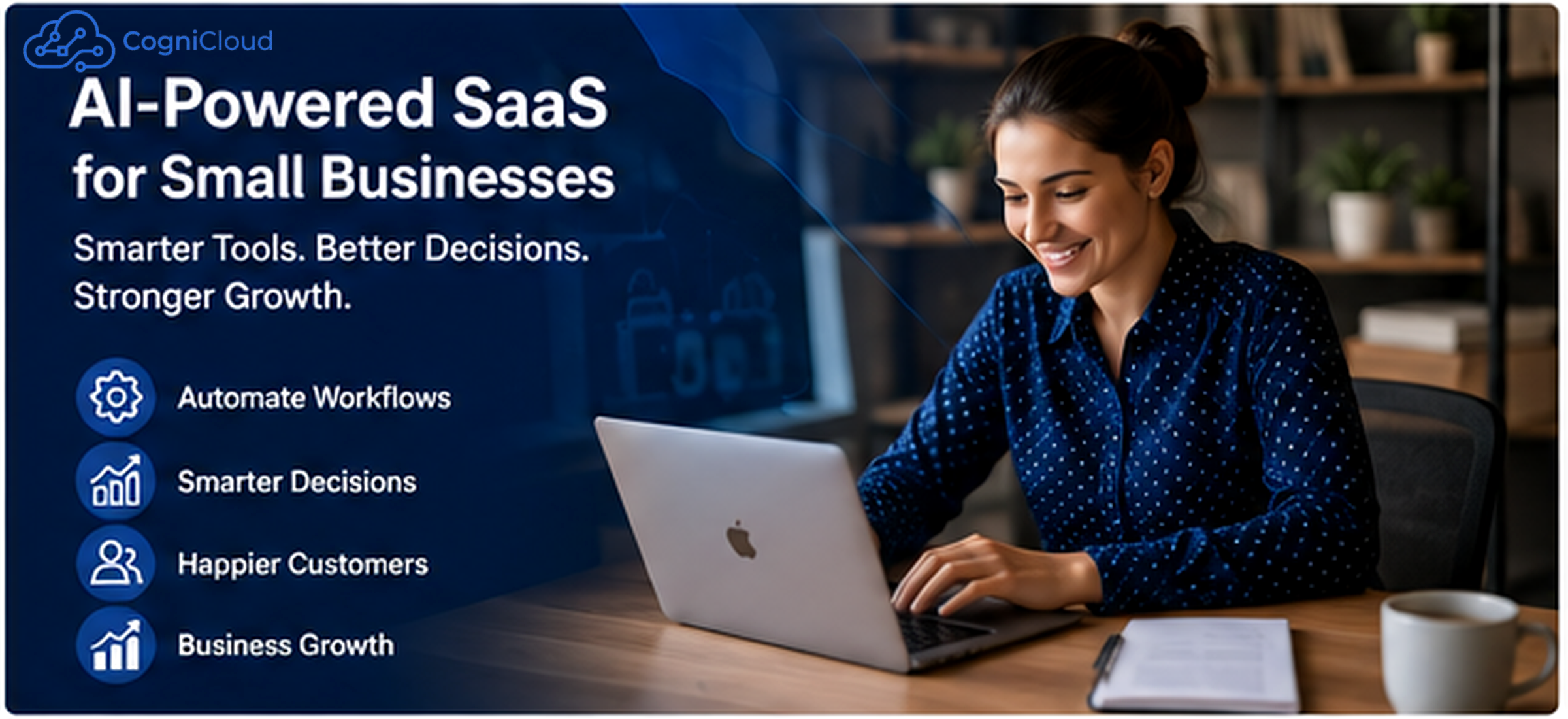
What Is AI-Powered SaaS?
SaaS is software delivered over the internet, normally through a browser or application and usually paid for through a subscription.
AI-powered SaaS adds capabilities such as:
- Natural-language interaction
- Machine-learning predictions
- Generative AI
- Document understanding
- Intelligent search
- Recommendations
- Workflow automation
- AI agents and tool use
Consider a traditional customer relationship management system.
A traditional CRM might store contacts, deals, notes, and activities.
An AI-powered CRM can additionally:
- Summarize customer conversations
- Identify important buying signals
- Draft follow-up messages
- Recommend the next sales action
- Extract information from emails and documents
- Detect deals that may need attention
The important change is that AI becomes part of the workflow instead of being a separate application employees have to open whenever they need help.
Why AI-Powered SaaS Matters for Small Businesses
Large organizations have historically had an advantage because they could afford specialized teams for sales operations, customer support, marketing, analytics, finance, and IT.
Small businesses rarely have that luxury.
AI-powered SaaS can give a small team access to capabilities that previously required more people or specialized expertise.
The goal is not to replace every employee with AI.
The goal is to give a small team more leverage.
A useful way to think about it is:
More work gets handled by software, while people spend more time on decisions, relationships, creativity, and exceptions.
How AI-Powered SaaS Works
At a high level, an intelligent SaaS workflow usually follows a simple cycle:

Data → AI processing → insights → action
The data might come from:
- Customer conversations
- CRM records
- Invoices
- Documents
- Website activity
- Product usage
- Support tickets
- Business databases
The AI layer can interpret that information and produce an output that is useful to the business.
The final step is where the real value appears.
Instead of only saying:
"This customer has not purchased recently."
A useful SaaS product might continue:
"This customer has not purchased in 90 days. Draft a personalized re-engagement email and create a follow-up task."
That is the difference between AI as a feature and AI as part of an operational workflow.
1. Automation Moves From Tasks to Workflows
One of the biggest changes is the move from simple automation to intelligent workflow automation.
Traditional automation usually works with explicit rules:
If X happens → do Y.
AI can work with information that is less structured.
For example, imagine a small business receiving customer inquiries by email.
A modern SaaS workflow could:
- Receive the email.
- Understand the customer's intent.
- Extract important information.
- Classify the request.
- Search the company's knowledge base.
- Draft an appropriate response.
- Update the CRM.
- Create a follow-up task.
- Escalate the conversation if human judgment is required.
The individual steps are useful, but the real benefit comes from connecting them.
2. Customer Support Becomes More Responsive
Customer support is one of the most practical applications of AI-powered SaaS.
Small businesses often cannot maintain a large support team, yet customers expect quick responses.
AI can help with:
- Frequently asked questions
- Ticket classification
- Knowledge-base search
- Conversation summaries
- Suggested responses
- Ticket routing
- Sentiment and urgency detection
- Support analytics
A strong implementation does not attempt to make every conversation autonomous.
Instead, it uses AI for speed and humans for judgment.
Routine questions can be handled automatically.
Sensitive, unusual, or high-value cases can be escalated to a person.
This creates a useful hybrid model:
AI handles volume. Humans handle judgment.
3. Marketing Becomes Easier to Scale
Marketing requires a surprising amount of repetitive work.
A small business may need to create blog posts, social media content, email campaigns, product descriptions, landing-page copy, and advertising variations.
AI-powered SaaS can help generate and organize much of this work.
For example, a marketing platform could take:
- Product information
- Target audience
- Brand guidelines
- Previous campaign results
and help produce:
- Blog outlines
- Social posts
- Email campaigns
- Ad variations
- Content calendars
- Customer segments
The important point is that AI should support the business's marketing strategy rather than replace it.
The business still decides what it wants to communicate.
AI helps turn that strategy into more output.
4. Sales Teams Can Spend More Time Selling
Salespeople frequently spend significant time on administrative work.
Updating CRM records, writing follow-up emails, preparing meeting summaries, researching prospects, and maintaining pipelines can take attention away from customers.
AI-powered SaaS can reduce this overhead.
After a customer meeting, a system could:
- Transcribe the conversation
- Summarize key points
- Identify customer requirements
- Extract objections
- Update CRM fields
- Create follow-up tasks
- Draft a personalized email
The salesperson reviews the result instead of starting from an empty screen.
That small change can compound across dozens of customer interactions.
5. Finance and Administration Can Become More Intelligent
Finance and administration contain many repetitive processes that are well suited to software automation.
Examples include:
- Invoice data extraction
- Expense categorization
- Payment reminders
- Document processing
- Purchase-order matching
- Cash-flow summaries
- Financial anomaly detection
Consider an invoice-processing workflow.
Instead of manually reading an invoice and entering every field, the system can extract:
- Supplier
- Invoice number
- Date
- Amount
- Tax
- Due date
It can then route the invoice for approval.
The important distinction is that AI should not automatically make every financial decision.
High-impact actions should retain appropriate approval and audit controls.
6. Business Analytics Becomes Easier to Use
Many small businesses already have valuable data.
The problem is that the data often lives across multiple systems, and analyzing it manually takes time.
AI-powered analytics can provide a natural-language interface to business information.
Instead of building a report manually, an owner could ask:
"Which products had the strongest sales this month?"
Or:
"Which customers have not purchased in the last 90 days?"
Or:
"Which support category generated the most tickets?"
A well-designed system can translate those questions into data queries, analyze the results, and present the answer in a form a business owner can understand.
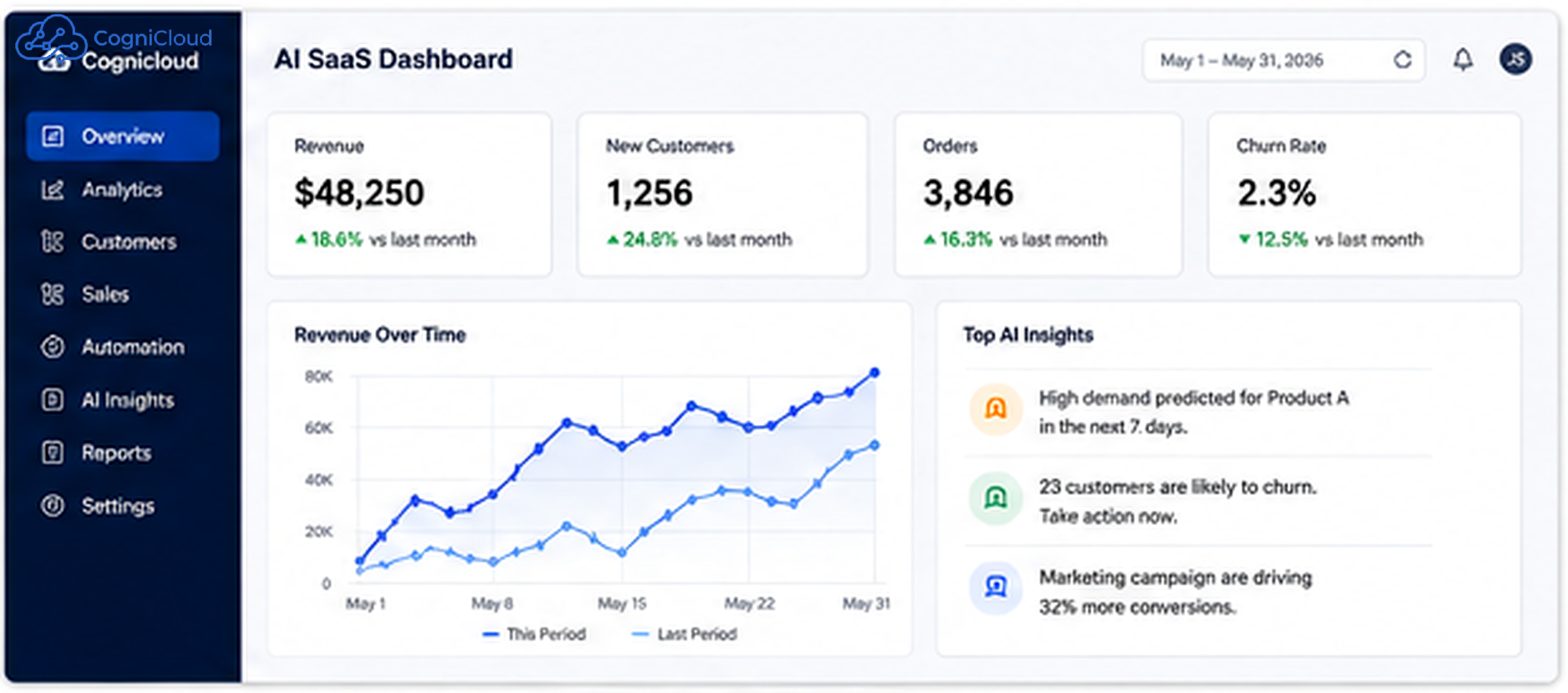
This makes analytics accessible to people who do not have a dedicated data team.
7. AI Helps Small Teams Operate With More Leverage
The biggest advantage is not any single AI feature.
It is the cumulative effect of removing small pieces of repetitive work.
Imagine a small team that saves:
- 30 minutes per day on administration
- 45 minutes per day on customer support preparation
- 30 minutes per day on reporting
- 45 minutes per day on marketing production
Those savings can add up to several hours of additional productive capacity every week.
The business does not necessarily need more employees immediately.
It can first make better use of the capacity it already has.
Real-World Example: A Small E-Commerce Business
Consider a small e-commerce company with a team of eight people.
Its challenges include:
- Responding to customer questions
- Writing product descriptions
- Monitoring sales
- Following up with customers
- Managing inventory information
- Preparing weekly reports
An AI-powered SaaS platform could connect these workflows.
For example:
Customer support
AI answers common questions using the company's approved knowledge base.
Marketing
AI helps create product content and campaign variations.
Analytics
AI summarizes weekly sales and highlights unusual changes.
Customer retention
AI identifies customers who may be ready for a repeat purchase.
Operations
AI extracts information from supplier documents and routes tasks to the right employee.
The team remains in control, but less time is spent moving information between systems.
8. The SaaS Interface Is Changing
Traditional SaaS applications are built around dashboards, menus, forms, filters, and buttons.
Those interfaces are not disappearing.
But AI is introducing another interaction model: intent-based software.
Instead of navigating through several screens, a user may be able to ask:
"Show me overdue customers and prepare reminder emails."
The application can interpret the request, retrieve the relevant data, generate drafts, and present the proposed actions.
This changes the relationship between people and software.
Traditional software asks:
"Which buttons do you want to click?"
AI-powered software increasingly asks:
"What are you trying to accomplish?"
9. AI Agents Will Push SaaS Further
The next step is agentic software.
An AI agent is designed to perform multiple actions toward a goal instead of simply generating a response.
For example:
"Find new prospects in our target industry, qualify them, add qualified prospects to the CRM, and prepare personalized outreach."
A traditional application might require the employee to complete each step manually.
An agentic SaaS product could coordinate several tools and actions to complete much of that workflow, while still requiring approval for sensitive operations.
This is likely to change SaaS architecture significantly.
Modern SaaS products increasingly need to think about:
- AI models
- Tool calling
- Workflow orchestration
- Permissions
- Data access
- Human approval
- Observability
- Audit trails
AI becomes another operational layer of the application.
10. Security and Privacy Become More Important
AI-powered SaaS often has access to valuable business information.
That makes security even more important.
A production-ready platform should consider:
- Authentication
- Authorization
- Tenant isolation
- Encryption
- Audit logging
- Data retention
- Least-privilege access
- Model and prompt security
- Human approval
- Monitoring and observability
For a multi-tenant SaaS platform, one customer's data must never become available to another customer.
AI does not remove this requirement.
It makes it even more important because models and agents may interact with business data and external systems.
Our previous article on building a multi-tenant SaaS platform on AWS explores these tenant-isolation principles in more detail.
11. AI Does Not Fix a Bad Business Process
This is one of the most important lessons for businesses adopting AI.
Adding AI to a poor workflow does not automatically create a good workflow.
A better framework is:
Problem → Process → Data → AI → Automation → Measurement
Start with a real problem.
Understand the existing process.
Make sure the underlying data is reliable.
Use AI where it provides a genuine advantage.
Automate only what can be automated safely.
Then measure whether the change actually improved the business.
The best AI automation is often surprisingly boring.
If it saves employees two hours every week and reduces mistakes, it is already valuable.
12. What Small Businesses Should Automate First
A practical starting point is repetitive, high-volume, relatively low-risk work.
| Business Area | Good AI SaaS Use Case |
|---|---|
| Customer Support | FAQ responses and ticket classification |
| Sales | Lead qualification and follow-up drafting |
| Marketing | Content creation and campaign analysis |
| Finance | Invoice and expense extraction |
| Operations | Workflow routing and notifications |
| Administration | Document processing and data entry |
| Analytics | Natural-language business reporting |
| Knowledge Management | Intelligent search and summarization |
The best first automation is usually not the most impressive demonstration.
It is the one that solves a real operational problem.
13. What This Means for SaaS Builders
The AI opportunity is equally significant for SaaS developers.
The winning products will not necessarily be the applications with the largest AI model.
They will be products that combine:
- A clear business problem
- High-quality domain data
- Strong workflow design
- Reliable integrations
- Useful AI capabilities
- Good user experience
- Security and tenant isolation
- Measurable business outcomes
AI should therefore be treated as a component of a SaaS product, not the entire product.
A reliable SaaS platform may use AI for reasoning and generation while using conventional software for:
- Authentication
- Billing
- Databases
- Permissions
- Deterministic business rules
- Reporting
- Audit logs
That combination is often more dependable than trying to make an AI model responsible for everything.
14. The Future of AI-Powered SaaS
The next generation of SaaS is likely to become more:
- Context-aware
- Predictive
- Automated
- Agentic
- Integrated
- Personalized
Instead of waiting for employees to ask questions, software will increasingly identify situations that require attention.
For example:
"Three high-value customers have shown a decline in activity. Would you like me to prepare a retention campaign?"
Or:
"Your support volume increased significantly this week. The main cause appears to be a recent billing issue."
The application is no longer just reporting what happened.
It is helping the business decide what to do next.
The Human Role Is Changing, Not Disappearing
AI-powered SaaS will automate many routine activities.
But businesses still need people for:
- Judgment
- Leadership
- Relationships
- Strategy
- Creativity
- Negotiation
- Risk management
- Accountability
The competitive advantage will come from combining human strengths with software capabilities.
The strongest small businesses will not necessarily be the ones with the most AI.
They will be the ones that know where AI should be used—and where a human should remain in control.
Final Thoughts
AI-powered SaaS is changing small businesses by making sophisticated automation, analytics, customer support, content generation, and operational assistance accessible through subscription software.
For a small company, the opportunity is significant.
A well-designed AI SaaS platform can help a small team:
- Automate repetitive work
- Respond to customers faster
- Make better decisions
- Reduce administrative overhead
- Produce more content
- Understand business data
- Scale operations more efficiently
But the goal should never be to use AI simply because it is available.
The real opportunity is to redesign business workflows around what modern software can now do.
The future of SaaS is not just smarter software. It is software that helps businesses get work done.
Sources and Further Reading
- U.S. Chamber of Commerce — Small Businesses Are Harnessing AI to Innovate and Compete
- U.S. Chamber of Commerce — Empowering Small Business: The Impact of Technology on U.S. Small Business
- World Economic Forum — Transforming Small Businesses: An AI Playbook for India’s MSMEs
- OECD — AI Adoption by Small and Medium-Sized Enterprises
- AWS — SaaS Architecture Fundamentals
- AWS — SaaS Lens for the AWS Well-Architected Framework
- AWS — Build AI Agents That Scale: A Systems-Oriented Reference Architecture for Startups